


The issue of paying college may be one of the largest financial choices students and families will ever have. As tuition prices keep increasing throughout the United States, knowing how to get financial aid is no longer a choice, it is mandatory.
Your Comprehensive Financial Aid Guide is set to guide students, parents, and adult students and learners confidently through the federal financial aid process.
You are a high school senior, transfer student, or have been out of school years and you have decided to go back to school and you want to know what the Free Application for Federal Student Aid (FAFSA) is, how it works, and how you can get as much of this money as possible. This guide will shed some light on the purpose of the Free Application to Federal Student Aid, how it works and how you can maximize your eligibility.
What Is FAFSA?
The Free Application for Federal Student Aid (FAFSA) is the form used by the federal government to ascertain the eligibility of a student in the financial aid of college or career school. The Department of Education in the U.S. conducts its administration via its Federal Student Aid office.
Through filing FAFSA, students can be eligible to receive:
- Federal grants
- Federal student loans
- Federal work-study programs
- State-based financial aid
- Scholarships and grants in the institution.
In short, the FAFSA is the opening to the majority of the need-based financial aid within the United States.
Why FAFSA Is So Important?
A lot of students believe that the FAFSA is only available to low-income families. That is incorrect. Income is not the only factor that determines eligibility for financial aids. The middle-income families are often eligible to receive the federal loans, work-study, or even part grants.
The importance of filling out FAFSA is as follows:
- Access to Federal Grants: Some of the programs like the Pell Grant are funds that are not required to be repaid.
- Eligibility of Federal Loans: The interest rates of federal loans are usually lower and the repayment plan is more flexible as compared to that of the private loans.
- State and Institutional Aid: Lots of colleges utilize the FAFSA information to give their own grants and scholarships.
- Work-Study Opportunities: Campus jobs provide federally funded jobs that allow students to earn money.
Although you may think that your family makes too much, you will not be closing the door by making the application.
Who is Eligible to Fill out FAFSA?
The brief response: virtually every person intending to join college in the United States.
You are to fill out FAFSA in case you are:
- You are a high school senior who is going to college.
- A student, who is attending college and needs further assistance.
- A transfer student
- A lapsed adult coming back to school.
- A graduate student or professional student.
Dependents and independent students are able to apply. Status of dependency has an influence on reporting of financial information, but does not hinder eligibility.
Financial Aid that can be received with the Help of FAFSA
Knowing what assistance can be provided you will see the significance of filling the form.
- Federal Grants
Grants are normally based on the need and do not have to be repaid. The most popular is the Pell Grant. The eligibility is based on financial necessity, enrollment and academic plans.
- Federal Student Loans
Loans need to be brought back in terms of repayment, however, federal loans usually provide:
- Fixed interest rates
- Repayment plans that are income-based.
- Deferment and forbearance alternatives.
- There are two primary types:
- Direct Subsidized Loans (need based)
- Direct Unsubsidized Non-need-Based Loans.
- Federal Work-Study
Work study gives students the opportunity to work half time as they pursue their studies. Employment is commonly in the form of a campus or a nonprofit organization sanctioned by the company.
- State and Institutional Aid
FAFSA information is frequently distributed to states and colleges to allocate:
- State grants
- Merit-based scholarships
- Institutional need based awards.
Every state has its delay lines and the necessities and thus, in order to submit a line in time it is very important to submit it earlier than the deadline.
Major FAFSA Changes You Need to Be Aware of
The FAFSA procedure has been updated in recent years. Among the major modifications, there is the Student Aid Index (SAI) in place of the Expected Family Contribution (EFC). Financial need is determined by means of SAI.
Moreover, the application process has also been simplified and more data is automatically passed through IRS tax records to minimize errors.
The Paperwork You Will Require Before Commencing
The process can be made easy by preparation. Prior to completing the FAFSA, you will need to provide:
- Social Security Number (or Alien Registration Number (when not a U.S citizen))
- Federal income tax returns
- W-2 forms
- Records of untaxed income
- Bank statements
- Records of investment (where appropriate)
The financial information of parent(s) of dependent students will also be required.
With such documents prepared, the chance of errors and time wastage is minimized and the submission process is fast.
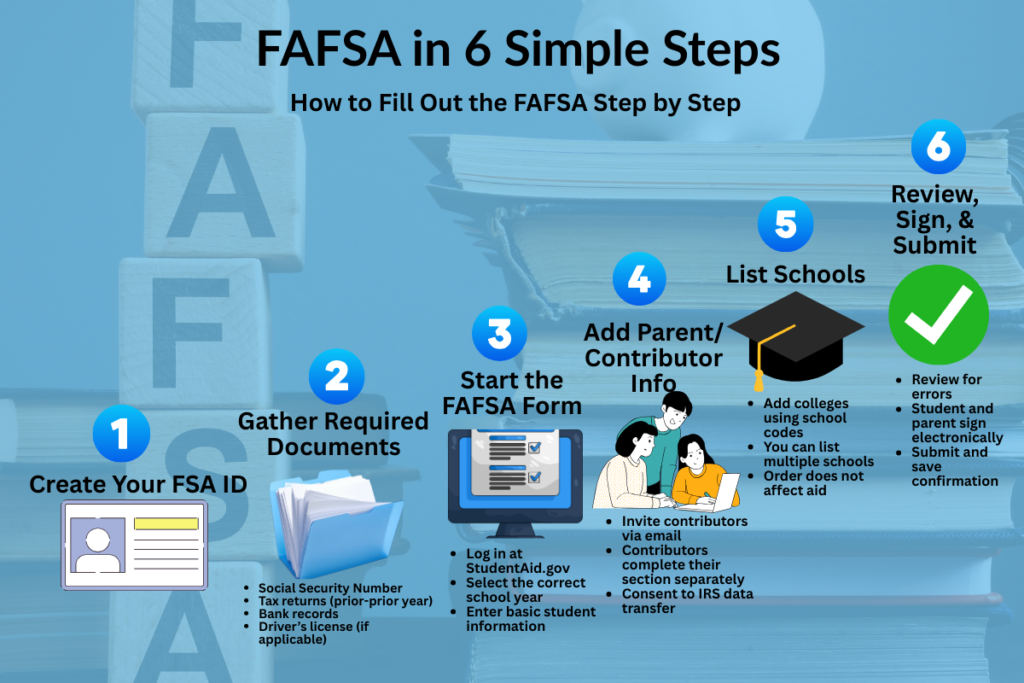
Step-by-Step: How to Fill in the FAFSA
The process can be simplified as follows:
Step 1: Create Your FSA ID
Parents and students have to establish FSA ID. This is used as your electronic version of signature and a login password.
Step 2: Launch the Application on the Web.
Visit the official FAFSA site. Select the right academic year.
Step 3: Give Personal Information
Provide the following information:
- Name (as it is written on your Social Security card)
- Date of birth
- Address
- School selection codes
Step 4: Add Financial Information
Improve tax entry by using an IRS data retrieval tool (where there is availability). This minimizes the mistakes and time loss on processing.
Step 5: Review and Submit
Close on all details before signing and submission. Electronic signature is necessary for students and parents (where necessary).
FAFSA Deadlines
FAFSA is also opened on a yearly basis and the deadlines are diverse:
- Federal deadline
- State deadline
- Institutional deadline
The aid is frequently handed out on a first come first serve basis. You have more chances of getting maximum help by submitting early.
Check state-specific deadlines always on the education agency website of your state.
Common FAFSA Mistakes to Avoid
Even minor mistakes are capable of slowing down processing. Avoid these common mistakes:
- Missing deadlines
- Keying in wrong Social Security numbers
- Forgetting to sign the form
- Listing the wrong tax year
- They did not cover all the necessary schools
Precision means that the processing is quicker and less complicated.
Knowing What You Got on Your FAFSA Results
Once it has been submitted, you will be sent a FAFSA Submission Summary. This document includes:
- Your Student Aid Index (SAI)
- Validation of information received.
- Estimated eligibility
This information will be used in preparing your financial aid offer in colleges you listed.
Comparison of Financial Aid Offers
After getting acceptance letters, you should also get financial aid award letters per institution.
These packages may include:
- Grants
- Scholarships
- Loans
- Work-study
Carefully review:
- Total cost of attendance
- Award size (grants/ scholarships)
- Loan amounts
- Out-of-pocket costs
Look not only at the overall price of the award. Look at the amount that has to be paid back.
Special Circumstances: What Will You Do in Case Your Financial Situation is altered?
If your family experiences:
- Job loss
- Medical expenses
- Divorce
- Important loss in revenue.
You may apply to your college financial aid office asking it to review your case in the form of a professional judgment. Schools are in a position to modify aid packages according to the recorded changes.
FAFSA for Independent Student
Students who are independent do not normally need to make disclosure of parental income. You can be considered independent whether you:
- Are 24 years or older
- Are married
- Have dependents
- Are a veteran
- Are in graduate school
It is important to know your dependency status in order to report accurately.
FAFSA and Graduate School
Graduate students qualify for federal loans but not Pell Grants. Even to get federal Direct Unsubsidized Loans and Grad PLUS Loans, it is necessary to fill in FAFSA.
Frequently Asked Questions
- Is FAFSA Really Free?
Yes. This is a fully free application. Keep an eye on third-party services, which require a fee.
- Is it possible to Update FAFSA?
Yes. Online corrections can also be made in case you find any mistakes.
- Is It Necessary to Complete the FAFSA Annual?
Yes. FAFSA should also be filled in yearly to remain in receipt of assistance.
Financial Aid Tips To Maximize The Financial Aid
- Apply as early as possible
- Triple check all information.
- List multiple schools
- Timely response to the verification requests.
- Find more non-FAFSA scholarships.
One of the funding puzzles is the financial assistance. Federal aid plus scholarships, saving and good borrowing.
Final Thoughts: Learn to Control Your Finances
Financing higher education involves completing FAFSA which can be overwhelming but it is one of the most significant steps. The FAFSA Guide: Your Comprehensive Financial Aid Guide has led you to understand what FAFSA is, why it is important, how to apply and how to interpret the results.
You will be putting yourself at the advantage of higher financial prospects and less student debt by taking the time to know how to do it and make your application well before the deadline.
Education is an investment. FAFSA makes such an investment cheaper, more affordable, and approachable to students throughout the United States.
There is no time to lose in case you are going to college. Complete or start your FAFSA and open the door to financial aid which can help you reach your academic potentials.
External Resources to Help You
To get proper, official information, refer to:
- Federal Student Aid: https://www.usa.gov/fafsa
- Tax guidance of IRS: https://www.irs.gov