

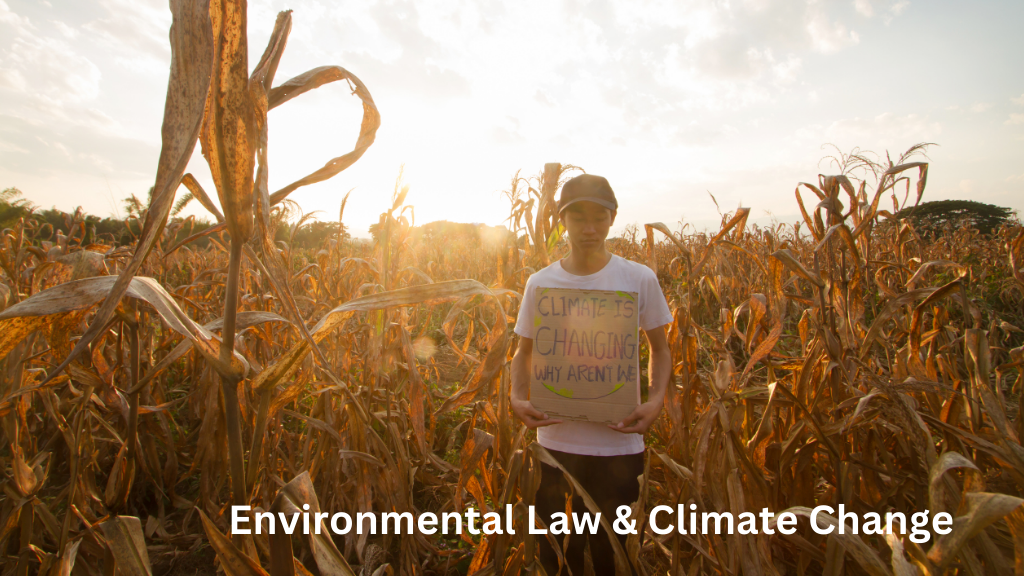
The environment law provides the necessary legal frameworks in addressing the issue of climate change. Other areas that are regulated under environmental laws including the air quality, water management, waste regulation, land use and biodiversity protection are directly affected by climate change, or have a substantial impact on greenhouse gas emissions. With the increase in risk of climate change, environmental laws are becoming more and more expected to incorporate climate mitigation, adaptation, and resilience goals.
Meanwhile, the issue of climate change reveals the loopholes and constraints in the current environmental laws. Legislations which were made to work in fairly stable environmental conditions now have to work in a state of uncertainty, rapid change, and increased risk.
By getting environmental law right in line with climate ambitions, it can contribute to the shift to net zero emissions, safeguard ecosystems, encourage training people in the process, and guarantee climate harm accountability. The importance of this relationship lies in the understanding of the relationship that policymakers, legal practitioners, businesses, and communities aiming to bypass the climate crisis need to understand.
Key Points
- Climate change is a pressing international problem in the ecological system and the societies of humans on the planet.
- Evident effects include increased temperatures, increased heatwaves, extreme weather, loss of biodiversity, ocean acidification, and rising sea level.
- Climate change poses a risk to food security, human health, infrastructure, economic stability and social equity.
- The fight against climate change is an issue that needs scientific breakthroughs, political will and effective law.
- Environmental law can guide action, impose responsibility, and secure long-term sustainability.
- Historically, environmental law covered pollution, natural resource protection, and human health.
- Currently, environmental law is at the forefront of climate regulation, addressing long-term global risks, cumulation, and intergenerational responsibility.
- Environmental law offers a means to lower greenhouse gas emissions, safeguard sensitive ecosystems, and enable adaptation to inevitable climate change impacts.
- Legal frameworks are critical to securing a just, sustainable, and climate-resilient future.
Relationship between Environmental Law and Climate Change
Initially, climate change was not the intention of the environmental law. The early environmental legislation was more concerned with the outward and local environmental problems such as industrial contamination, improper treatment of garbage, contaminated water, and habitat destruction. These laws were supposed to deter the damage and regulate the specific operations rather than focus on the international and extended environmental risks.
Climate change has transformed this radically. It affects nearly all the environmental systems that are under the law like air, water, land and biodiversity. Growth of temperature and change in the weather pattern influences the degree of pollution, health of the ecosystem, the availability of resources, and exposure of human beings to hazards in the environment.
As a result, the climate factor has become more of a distinct aspect of environmental legislation in the field of regulatory decision-making. It is a symptom of a more significant shift of environmental governance, in which the reactive regulation is replaced by a proactive one, based on risks, and considers future climatic conditions. The environmental law is now important in guaranteeing uncertainty management, sustainable development and coordination of the short term decisions to long-term climatic objectives.
UK Framework for Environmental Governance and Climate Action
The UK legal framework of environmental regulation and climate-based environmental protection can be largely shaped by the Environment Act 2021 that provides a legislative framework of long-term environmental regulation. The Act encourages legally binding priorities in the areas such as air quality, water, biodiversity and resource efficiency/waste, and strengthens legal foundations on environmental outcomes with climate-resilient outcomes, as well.
Among the principal institutional features, it is possible to identify the creation of the Office for Environmental Protection that is an autonomous organization, the task of which is to check the adherence to the environmental laws as well as to prosecute the government authorities. Though this is not a climate-individual responsibility, a closer management of environmental obligations can indirectly affect climate consistent results especially in the areas of overlap between a reduction of emissions, ecosystem protection, and climate resilience.
How Climate Change Is Impacting Environmental Law
Climate change has been changing the environmental legislation in the different areas whereby the existing regulations need to adjust to the prevailing environmental conditions and emerging environmental threats.
Waste Management
The Waste management laws were customarily aimed at the prevention of pollution, the safeguarding of human health and providing safe disposal of solid and hazardous waste. Climate change has broadened this area of concern through the emphasis of waste to greenhouse emissions and specifically methane emission through landfills and waste treatment plants.
UK legal/ regulatory hook: The Environmental pollution control and the control of the waste sites by the Environment Agency in the UK are central in the waste sites in the operation of the pollution controls and the operational risk like the consideration of the risk posed by climate.
Compliance/litigation risk: In situations where climate risks are predictable and operators do not modify their controls, the chances of an enforcement action or civil actions are more likely to be implemented after a pollution case occurs.
Water Regulation
Water resources are considered as one of the most environmentally sensitive factors. The shift in the patterns of precipitation, the increase in the frequency of drought, intensification of floods and the effect of water quality due to the development of high temperatures and pollution runoffs are the consequences of the climate change.
These variations create immense strain on the water laws which were traditionally calculated according to the historical data and assumptions of the climate.
UK legal/regulatory hook: Flood and water risk governance by Flood and Water Management Act 2010 assists in developing a framework in which there are recognizable and local/regional actors with definite responsibilities of flood risk management and controls in plan making processes.
Compliance/litigation risk: As the extent of flooding increases, the probability of foreseeable pollution happening also increases and the history of enforcement policies has been that large-scale incidents can attract substantial fines particularly when it is ascertained that the action taken to prevent them is unsatisfactory.
Deforestation
Deforestation causes and affects climate. Deforestation releases the carbon that is stored and reduces the ability to store the carbon in future. Meanwhile, rising temperatures, drought pressure, pests, and wildfire threat have the capacity to accelerate the decline in forests and reduce the strength of an ecosystem.
UK legal/regulatory hook: UK climate and environmental policies continue to overlap with supply-chain and land-use policies, including regulations aimed at making the UK less supportive of demand on commodities associated with forest-risk activities.
Compliance/ litigation risk: Supply chain deforestation is becoming a costly business liability as the need to report and the pressure to implement the environmental and consumer protection laws are increasing.
Air Quality and Atmospheric Protection
Climate change mitigation and air pollution regulation are two concepts that go hand in hand. Numerous of the activities that release greenhouse gases, including fossil fuel burning, transportation, and industrialization, are some of the activities that release air pollutants that pose threats to human health.
Environmental regulations touching on quality of the air thus have a dual purpose to not only safeguard the health of the people but also climate action.
This linkage has been acknowledged by courts in a number of jurisdictions and has forced governments to increase air quality standards in cases where current measures are not performing their duty legally.
These rulings indicate that even without the treatment of specific legislative measures on climate, it can be seen how the environmental law can indirectly serve climate objectives through the treatment of both environmental and health issues simultaneously
Air quality plans and statutory pollutant limits have been pressured by litigation and review, including actions by ClientEarth that challenged the adequacy of government planning around air pollution.
Biodiversity
The problem of climate change has turned into a significant challenge to biodiversity that intensifies changes in habitat, migration of species and degradation. The environment regulations which are supposed to safeguard the species and habitats can no longer spare the collapse in the environment where the environment is fast extending to the regions of climatic stress.
Conversely, it is also worth noting that ecosystems are important in adaptation and mitigation of climate change. Forests, wetlands, and coastal ecosystems are just some of the examples of ecosystems that serve as carbon sinks and natural floodwalls, defense against the effects of climate change.
Climate action has involved the application of environmental law that protects and preserves these ecosystems and acknowledges their contribution to enhancing climate resilience.
How Environmental Law Supports Climate Action
Mitigation Through Environmental Law
Environmental law supports emissions reduction through regulatory tools that control high-emitting activities, require cleaner operations, and increase transparency.
Regulatory Standards, Permits, and Disclosure
Some of the standards that are used in environmental law include pollution standards, environmental harmful activity permits and monitoring and reporting. These standards are also applicable in the control of greenhouse gas emissions and there is mounting pressure on the business to measure and manage their carbon footprint.
With the help of powerful standards, environmental law helps in promoting clean technology and sustainable business practice. This act also helps to provide fair competition since all companies are expected to comply with the same standards of greenhouse gas emissions. Moreover, the environmental law helps to achieve transparency and public reporting that enables the stakeholders to monitor the progress.
Polluter Pays Principle
One of the foundations of environmental law is the polluter pays principle. It obligates the offenders of environmental degradation to assume the cost of preventing, controlling and cleaning up. When used in the context of climate change, the principle is supporting carbon pricing, emissions trading, and claims of liability in relation to climate change.
This principle encourages more responsible and equitable practices by having the price of the emissions internalized, which consequently encourages the reduction of emissions and the adoption of sustainable practices
Precautionary Principle
The precautionary principle provides regulators with the opportunity to act in order to avert severe or irreparable damage to the environment when scientific evidence is not complete. This principle is especially significant considering the magnitude and irreversibility of the effects of climate.
The precautionary methods have been applied in environmental law in order to justify early intervention, greater standards, and long-term planning, so that high-emission or climate-exposed infrastructure is not locked in.
Adaptation With Environmental Law
Adaptation is becoming a necessity due to the fact that not all the effects of the climate can be avoided in the nearest future. The law on the environment helps accommodate the adaptation through the incorporation of climate risk into the planning, infrastructure, and ecosystem management.
Climate-Sensitive Environmental Impact Assessment and Planning
Forward-looking climate risk can be included in the environmental impact assessment and planning controls. This aids the decision-makers to shun the clearance of development that augments the vulnerability in flood-prone regions, heat-prone areas, or shoreline sections susceptible to the surge of the sea level.
Natural Systems for Resilience
Environmental law is also helpful in adaptation to preserve and recover ecosystems with important climate buffering, wetlands, forest, and coastal habitats to store carbon, decrease flood hazards, and reduce soil erosion. This makes it stronger and will bring biodiversity and long-term sustainability.
Climate Change and Public International Law
Climate change is a transnational issue which needs international collective action. The principles of collaboration are found in the public international law, which offers the structures of cooperation in the form of treaties, conventions, and multilateral agreements that create general principles, obligations and mechanisms of collective actions.
The climate change policies and the Paris Agreement are regulations in the policies of the countries, which are guided by the United Nations Framework Convention on Climate Change and shape the national environmental policies. Such agreements promote openness, global collaboration, and growing ambition in the long run and inform the future of environmental law in terms of global climate targets.
They also facilitate financial and technological assistance to the developing countries as they understand that they have different capacities and responsibilities.
International climate law promotes accountability and continuous improvement through reporting requirements and global stocktake procedures, which enhances the use of environmental law in the realization of global climate objectives
Climate Justice and Equity
Climate change poses serious concerns of equity and fairness. The communities that imposed the least contribution to the global emissions are usually the ones who bear the worst effects of climate changes such as displacement, food insecurity, and health hazards.
Environmental law also has a significant role in ensuring that climate justice is enhanced through safeguarding of the vulnerable groups, participation of the people, and also in ensuring that there is access to legal intervention in the process of making environmental decisions.
Conclusion
Climate change and environmental law are two concepts that cannot be separated. Environmental law offers the legal tools to undertake climate mitigation, adaptation, accountability, and justice, and climate change is transforming the environmental law itself.
Powerful, dynamic, and binding environmental regulations are prerequisites to the solution of the climate crisis and a sustainable and robust future for future generations.
References
- https://www.cr2.cl/eng/policy-brief-how-do-we-connect-some-of-the-legal-principles-of-environmental-law-to-the-framework-law-on-climate-change/
- https://globaljustice.yale.edu/oslo-principles-global-climate-change-obligations
- https://www.legislation.gov.uk/ukpga/2021/30/contents
- https://www.theoep.org.uk/office-environmental-protection#:~:text=The%20Office%20for%20Environmental%20Protection%20%28The%20OEP%29%20is%20a%20public,other%20public%20authorities%20to%20account.
- https://www.gov.uk/government/organisations/environment-agency
- https://www.legislation.gov.uk/ukpga/2010/29/contents
- https://www.clientearth.org/
- https://nbn.org.uk/wp-content/uploads/2019/09/State-of-Nature-2019-UK-full-report.pdf
- https://www.iisd.org/articles/polluter-pays-principle
- https://www.iisd.org/articles/deep-dive/precautionary-principle
- https://www.eli.org/vibrant-environment-blog/rise-climate-change-adaptation-law
- https://lawclimateatlas.org/resources/public-international-law-and-climate-change/
- https://www.unwomen.org/en/how-we-work/intergovernmental-support/climate-change-and-the-environment/united-nations-framework-convention-on-climate-change
- https://www.cambridge.org/core/journals/leiden-journal-of-international-law/article/abs/fairness-equity-and-justice-in-the-paris-agreement-terms-and-operationalization-of-differentiation/4AD4C512175ECFC80F14083BDAB4CA1A