
How to Talk About Grief with Children and Young Adults
When something painful happens, a death, divorce, a significant move or a child’s world changes, the world seems to have been turned upside down. Often, adults are clueless about what to say. They are afraid to make it worse and remain silent. Refusing to say anything doesn’t save children from loss. It leaves them in isolation.
Children experience the loss very intensely. They express it in a different way from adults, and require different forms of support based on their maturity and age, and what they have experienced. This guide will help you to understand children’s reactions to grief, how you can make it easier to talk about loss and how to offer helpful and supportive care.
Key Takeaways
● Grief is more than just about dying. None of these are easy experiences and a major life change such as divorce can result in major grief for children and teens. Being separated by divorce, a major move, losing a pet, or losing a friend or relative can cause children and teens to experience grief.
● Grief has no stages or timeline. There are usually no definitive stages or timeframes to grief. Coping isn’t a linear process of grief, as the old notion of a five-stage grief cycle suggests. Each child will experience grief in their own unique way and there is no “right time” or “right way”.
● Use honest, direct language. Use words such as “Died” and “Death” which are clearer and kinder than words such as “Passed away” or “Gone to sleep” that are more confusing to children under the age of 5.
● Guilt is very prevalent. When kids feel that something is missing, they often blame themselves and don’t tell anyone. Explain to them clearly and often that it was not their fault.
● Professional support is provided and effective. Mayo Clinic Health System says grief counseling, support groups and therapy may help for kids who have trouble.
Grief Is More Than Just Death
Many people believe that grief only occurs upon death. Grieving is any deep feeling of reaction to a significant loss and children can react to a loss in many different ways.
Sure, death is a cause of sadness. But so do divorce, a parent’s deployment, moving to a new city, a pet dying, a close friend dying, and a big life change such as starting at a new school.
Adults often think that what might be “not that big of a deal” might not impact a child/teen as much, but it can, and it can have an impact as severe or even more severe as death.
Grief can manifest itself in many ways – even when a person is leaving behind a positive experience, such as graduating or relocating to a new school place, often with older children and young people that are leaving behind what is familiar and comforting.
The key is this: grief is unique to each person. Some children may be affected in a very small way if something happens, while for others it can be a significant event. We cannot assess others’ grief according to our own rules and decide whether or not it is “serious enough” to grieve about. All forms of grief are entitled to be acknowledged.
The “Stages Of Grief” Are Out-Of-Date

Many people are familiar with the five stages of grief that are denial, anger, bargaining, depression and acceptance. It didn’t become popular, however, until 1969 and was never intended to be a set of steps. It’s been used by many people though.
The trouble with stages is that grief is neat and linear. The reality of grief is neither/or. Children’s grief is not a straight forward process. Children circle back. Children appear to be okay and then they cry again. Children make jokes at funerals and cry about other issues weeks later. That is not a bad thing, it’s what grief does.
Reference to “stages” and attempts at “moving on” to the next stage conveys the message that the child is grieving too long or that they are grieving in the wrong way. This will cause the already hurt person to feel bad about him/herself.
There is no definite time frame for grief. Grief is not “getting over it”. The real work of bereavement is to learn to live with it and to create a life that encompasses the loss.
How Children Experience Grief at Different Ages
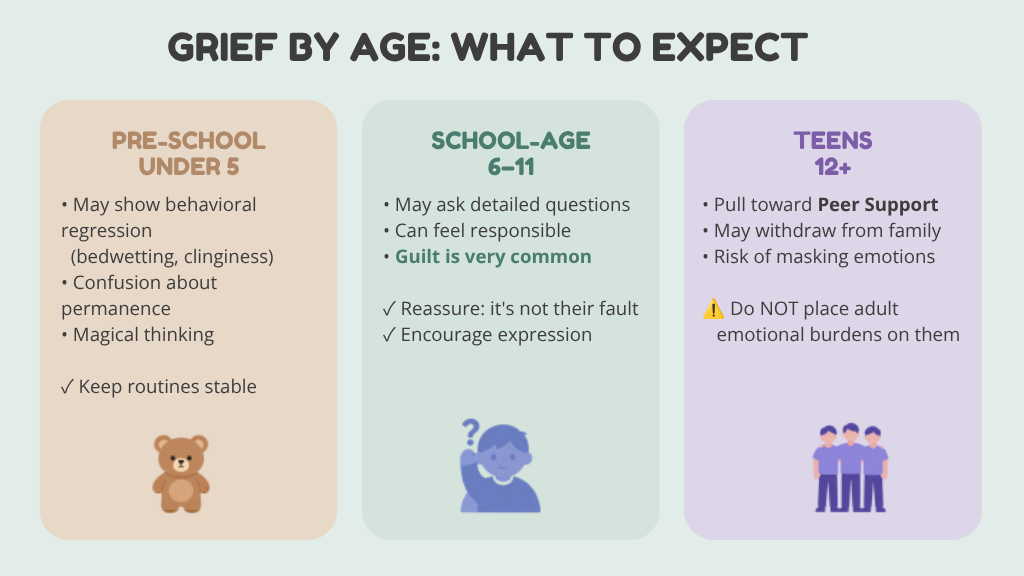
Children’s grieving is age-dependent and maturity-dependent. When you understand what’s normal for each stage, you’ll be able to provide the appropriate support.
Young Children (Pre-school age 5)
Young kids are not typically capable of grasping the finality of death. They might not necessarily understand that someone who is dead is not coming back, or the full implications of a family moving or breaking up.
They seem to show their grief through their behaviour. They might hang on to familiar people or things. They may regress: begin to act younger than they are, such as resorting to a pacifier or using baby talk. They may have difficulty sleeping or eating.
Keeping their daily routine as stable and predictable as possible is one of the most comforting things you can do at this age.
School-Age Children (Ages 6–11)
For children in this age group, they have a greater understanding of what loss entails. They know that death is final and that a person who left a place is not likely to return for a long while, and that divorce alters family life forever.
They can experience guilt. They might repeat words they’ve said or not said prior to losing. They might be upset because of their own feelings, the person who died, or the circumstances. Disturbances to eating, sleep and behaviour are very prevalent.
These kids might also be concerned about their own death, and if others they love will be taken away as well. Don’t get impatient if questions are repeated. Be honest with them, all the time.
Adolescents and Teens (Ages 12 and Above)
It’s possible that teens grieve much like adults do. They know that things can never be renewed and that it can happen to everyone – even them. Knowing that can be daunting and weighty.
Teens can become distant from the family and turn to their friends for support. They may challenge their religion, their doctor, their leaders or their concept of justice. They can experience a lot of feelings, such as feeling helpless and anger. Some will not be willing to cry in public, or discuss their emotions.
Older teens also can fall into the trap of taking on adult responsibilities that they aren’t prepared for, such as being responsible for looking after the rest of the family or having to “be strong. This can deprive them of being able to grieve themselves.
Allow teens some privacy, but don’t be absent. Stay available. Don’t make contact unless it’s necessary to have a conversation. Don’t ask them to carry the emotional burden that goes with the adults in their lives.
How to Talk About Grief: Practical Guidance
Be a Safe Space First
Most importantly, let the child know it’s okay to feel whatever he or she is feeling. All this is fine – sad, angry, confused, relieved, guilty. Be honest and say, “You can talk to me about this – whatever you’re feeling is okay – I’m not going to judge you.
Children might not speak up if they don’t want to make the adults in their lives feel bad. If they are allowed to grieve openly, it will remove this burden from them.
Use Honest, Clear Language
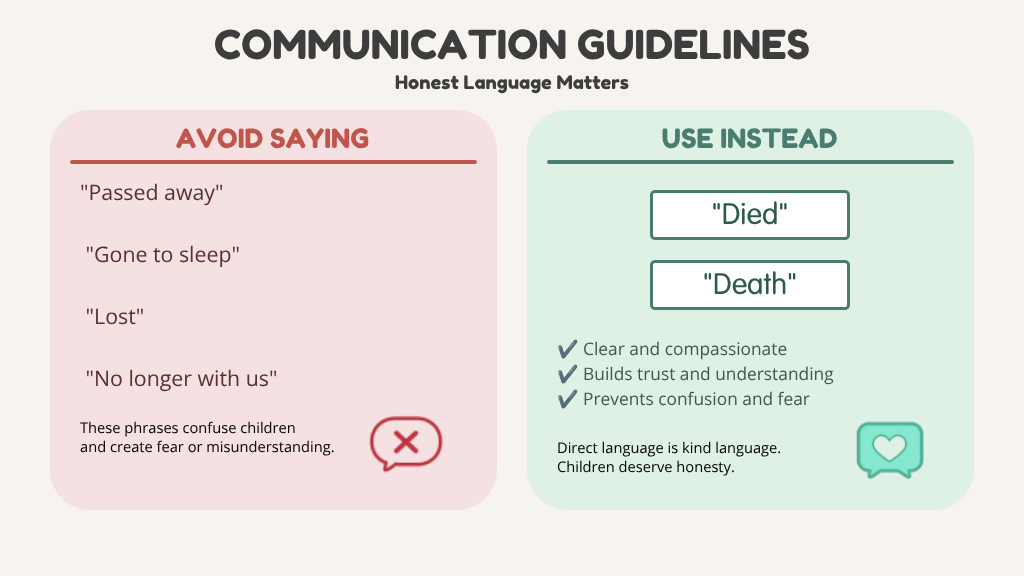
This is much more important than many people realize. Avoid using expressions such as: “passed away,” “gone to sleep,” “lost,” “went on a long journey. The following phrases, intended as helpful, really mix it up for little kids. If a child hears the word ‘sleep’ with the implication that someone has ‘gone to sleep’, he/she might fear going to sleep at night. If a child is told that someone they love is “lost,” the question that might come to their mind is why no one is searching for them.
Use the words “died” and “death. They are simple, sincere, and ultimately more compassionate than ambiguous and misleading hopeful phrases.
Answer the Question Honestly
Children should have an understanding of how and what has occurred. Explain things in a simple and direct manner without using jargon, as per their requests. You don’t have to tell them in graphic terms – you just have to give them the correct and accurate picture.
After you’ve explained something, check in. Have them inform you what they learned. Young kids can have received a message very different from what you’ve conveyed — and it’s much better if they fill the void with the truth than with fear.
Don’t Force It- But Don’t Disappear Either
Children can talk about things at any time — outside of lessons, at lunchtime, when using dolls and blocks, and so on. They might not want to discuss things in a formal sit down discussion.
Let them come to you. Offer your presence and your availability. If they are not ready to talk, don’t talk. It is a very powerful kind of support to be close, calm, consistent and available.
Respect How They Grieve
Each child responds differently! One child may be the talker. A second will remain silent. One may cry. It is possible that some dive into athletics or studies. Encourage their coping strategies as long as they are safe and healthy.
It is okay, and healthy to grieve in the following ways: Drawing, journaling, playing music, spending time outside, or keeping busy. Avoid pressuring them to grieve in a manner that you think is right.
Things That Actually Help
Keep Routines Stable
The regularity of everyday life is reassuring for younger children in particular. Establish regular routines for times at meal, bed and other activities. This provides children with a feeling of security when little else in their lives is.
Keep traditions alive for seasonal or holiday routines. If a major move has changed the family dynamic and the family has lost its feeling of home, provide familiar elements, familiar items, familiar foods, familiar surroundings, to help children feel at home.
Create Ways to Remember
Strive to help children develop a relationship to their loss. Make a memory box with pictures and small trinkets. Make a scrapbook. Encourage them to write letters to the person who has passed away. Many families stitch a quilt together from the loved one’s clothes for the kids to snuggle under and into.
Call out the name of the person. Talk about them. Speak with them on significant dates. It’s one of the worst things to do: pretending a person never existed, a child’s feelings are harmed if, for example, they feel it’s not safe to say that the person is missing.
Respect Grief Triggers – Do Not Avoid
A certain song, a familiar smell, a random Tuesday afternoon, grief can be triggered by anything, at any time. This is a surprise and can be frightening to kids.
Assist them to realize that it’s ok for this to happen. They do not indicate that it is abnormal. They are only a testament that they loved someone. On target, provide soft input: “Would you like to talk about it? Wanna take a break? Would you like to draw what you’re feeling?
Let Them Know Grief Isn’t on a Schedule
It will be required to inform the children that crying on time is not required. Crying does not mean that numbness is a sign of sadness during the funeral service. It is not like some kind of deadline by which they would not be grieving. Even if they are not sad for weeks together and then suddenly cry when celebrating someone’s birthday, it is perfectly fine.
It will be required to inform them that it is fine for them to inform their friends that they are having a bad day. It will be required to inform them that it is all right to cry. It is important to tell them that anger is one of the components of grief. They have challenged authority and God and it is absolutely fine.
Supporting Teens Specifically
Teens are particularly susceptible when it comes to grieving. They comprehend what losing someone means in the same way adults do, yet they lack emotional maturity. They have not developed the skills and mechanisms that come with age and experience.
If you have a good relationship with your teenager, he or she will feel comfortable talking to you. But teenagers generally prefer to talk to those of their own age, which is completely normal. Peer counseling services (teen to teen) where teens can discuss their experiences of losing someone with other teens who have gone through something similar have proved to be very effective. There are such programs at many schools and even national organizations help schools implement these programs.
All that teenagers expect from adults is to be there without any pressure. Drop by. Be accessible. Don’t make them open up right away. Don’t make them fill the empty space left by the one who passed away.
When to Get Professional Help
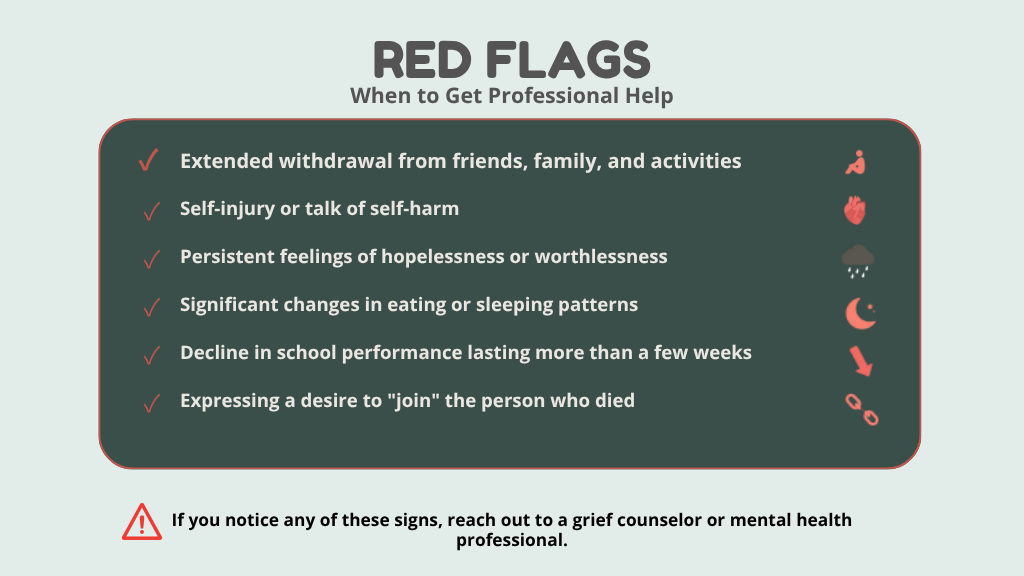
Talking to a parent/carer helps. But a trained professional can offer something different – a non-judgmental, competent setting where children can explore feelings they may not be ready to discuss anywhere else.
If you notice these, please get help from a professional:
- Severe withdrawal for an extended period of time
- Significant changes in sleeping patterns, food intake, or school performance
- Behavioral problems such as aggressiveness or defiance
- Evidence of self-injury
- The child indicates feelings of hopelessness or wishing he/she was dead
Individual therapy (one-on-one with a therapist), family therapy (family adjusting together) and grief support groups (children meeting other children with similar losses) are all types of support that are available.
One of the most widely used and effective methods for children to grieve is cognitive behavioral therapy (CBT). It assists them to identify unhelpful thinking patterns, develop healthy coping strategies, and to work through their emotions in a structured manner. A therapy that many therapists recommend for kids who have suffered from significant trauma is EMDR.
Frequently Asked Questions
- What can trigger a child’s experience of grief?
Real grief can happen for many reasons beyond the loss of a life, such as divorce, a big move, losing a pet, a friendship, the deployment of a parent, and even a significant life change in the child’s life. It is not acceptable to say, “Well, that isn’t serious enough. Children feel sad about any loss or change in their lives.
- How can I tell whether my child is grieving when he/she appears to be fine?
Children may go through grieving stages in small increments – sometimes they are fine and the next moment they are not. They might not be able to verbalize it, but be thinking about it. Pay attention to changes in sleep, eating, behavior, and mood even if they do not verbalize it, as an indicator that a child may be struggling.
- Should I use the terms “died” and “death” with small children?
Yes. Avoid using euphemisms; use clear, direct speech. Words such as “passed away” or “gone to sleep” or “lost” might mislead young children and create confusion and fear or false hope. Honesty is the best policy and saying “died” is true. Honesty is the best policy and it helps children to heal.
- Is it normal for a teen to appear to be untouched by a loss?
Yes, it can be. Adolescents tend to lie down in grief or with other teens, not with family. On the outside they might appear fine, on the inside they might be eating their way through their own skins. Don’t push them, stay present and check in at a time when they are ready to share.
- What should be the duration of grief in children?
No time limit. Grief does not have a timeline and there is no such thing as “when a child is ready/when he/she is done. They could experience the loss again at various life stages as they came to know in their life. This is a normal and healthy occurrence, rather than a problem.
Final Thoughts
There is no magical thing you could say to your grieving child. But there is a right way to do it, and that is being honest, going at a person’s pace, and letting them grieve, without judgment, without time constraints.
Children will not ‘get over’ grief. Instead, it will be something that they learn to bear. It is possible for them to endure it, if they get the proper support. They can live an abundant and satisfying life in the midst of sorrow.
There’s no right or wrong answer. You only have to be there.